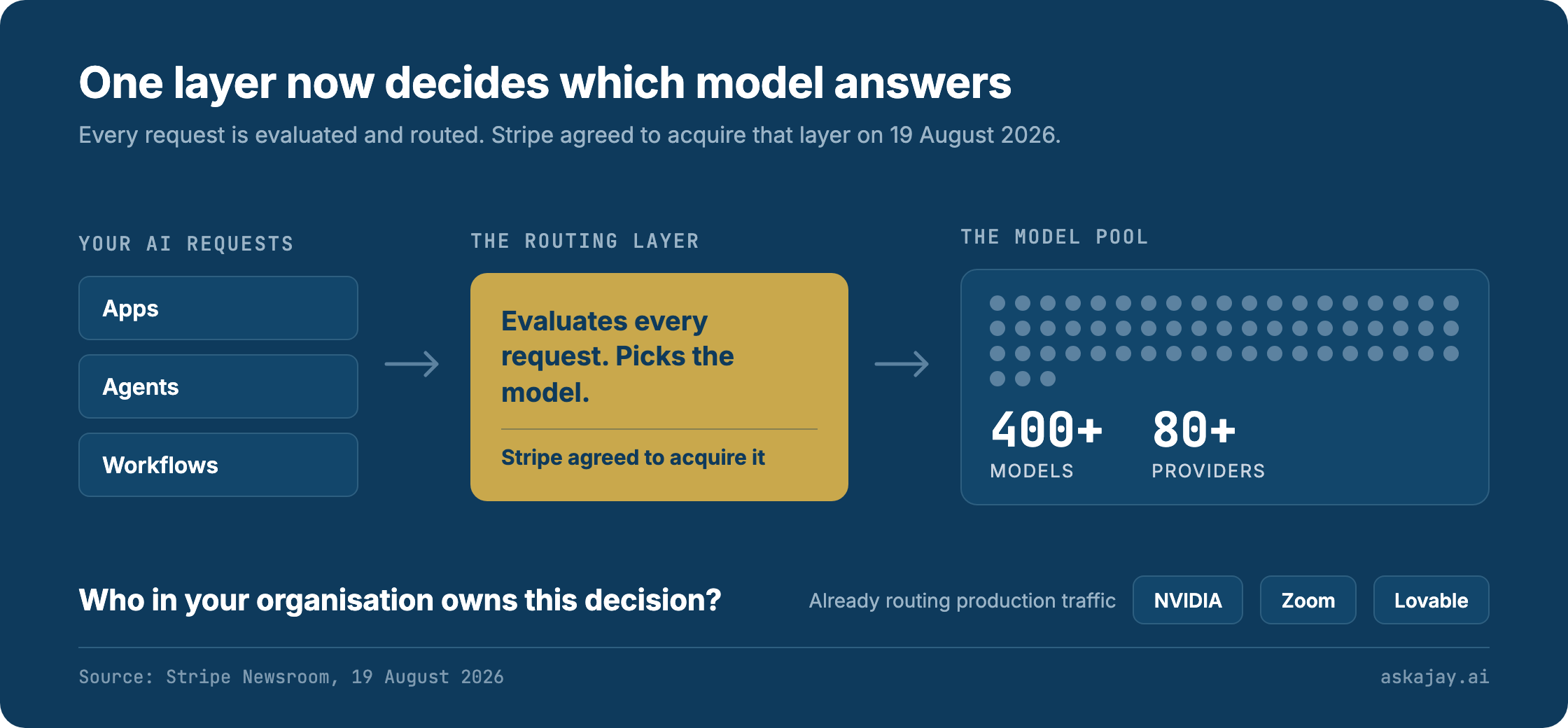
On 19 August, Stripe announced it had agreed to acquire OpenRouter, the service that sits between a company's application and the market of AI models behind it. OpenRouter evaluates every request the moment it arrives and sends it to whichever model wins on task complexity, price, speed and reliability, across more than 400 models from more than 80 providers. NVIDIA, Zoom and Lovable already route production traffic through it.
Patrick Collison, Stripe's chief executive, described the logic plainly. "Tokens are the central currency for companies building with AI, and it's clear that the real-world economic potential will depend on making good use of scarce compute resources." A payments company just called token routing a currency problem, which is the language of someone who intends to meter it.
Alex Atallah, OpenRouter's chief executive, framed it from the other side. "Stripe has spent over a decade building trusted, neutral infrastructure for businesses, and OpenRouter was built on the same philosophy." Two companies that each describe themselves as neutral plumbing have just become one company. Neutral plumbing that also owns the meter is not the same thing as neutral plumbing.
Here is the turn. Model routing used to be an engineering decision, a line in a config file: which API key, which failover path if a provider had an outage. It is now a spend decision with a margin on it, and in most companies it is still owned by whoever wrote that integration years ago and never revisited it. Ask around your own organisation and see how quickly anyone can name that person.
The Decoder
A model gateway, sometimes called a router, is the layer software teams build or buy so one integration can call GPT, Claude, Gemini or any open-weight model without the application caring which one answers. OpenRouter is the largest independent example of it, evaluating every request against cost, speed and reliability and often choosing a different model per request rather than per deployment.
That is why "we use OpenAI" has stopped being a true sentence inside most enterprises with any AI maturity. The application calls a gateway. The gateway calls whichever model clears the bar that hour. Nobody signed a contract for that specific model, and in most companies nobody can say with confidence which one answered the last ten thousand requests, let alone who chose the rule that picked it.
The Steelman
Keep the scepticism, because the case that this is ordinary infrastructure is real. Routing software exists so application teams stop hand-rolling failover logic, and in OpenRouter's own telling it is simply "the first and largest model marketplace and gateway," a convenience layer, not a strategic asset. Most procurement decisions about middleware never reach a board, and this one probably should not either. Buying a routing company is closer to buying a payment processor's fraud engine than buying a media company.
The honest counter is narrower than the headline. Nobody is proposing you brief the board on a router. The proposal is that someone below the board should own it, and right now in most companies nobody does.
Neutral plumbing that also owns the meter is not the same thing as neutral plumbing. The question is whether anyone in your company is watching it.
One question turns this from a headline into a Monday problem. If the model answering your highest-volume workload changed tomorrow, on cost or on capability, who in your company would notice first, and would it be someone whose job is to notice, or a customer complaint?
If you want to work through who owns that decision, and what it is costing you, the Situation Room is where I do that live with you, not as a download.
The Playbook
Start with a fact most companies do not have on hand. If your product calls more than one AI provider today, whether through your own code or through a gateway like OpenRouter, somebody set the rules for which model answers which request. Those rules touch cost per request, latency, and increasingly which provider's terms and data practices govern each answer. That is closer to a vendor-concentration decision than a technical footnote, and it belongs on the same list as who owns your cloud contract or your payment processor relationship.
Most organisations cannot answer three questions about it. Who decided the current routing rules. What changes if the cheapest model this month is not the most reliable one next month. And who finds out if a provider quietly changes what a model does without changing its name.
The Monday move. Pull up your AI spend for the last billing cycle and find the largest line item running through more than one model or provider. Name the person who owns that routing decision today, in writing, even if the honest answer is nobody. Then ask one question: what would have to happen for the model behind that spend to change without anyone finding out first. If nobody can answer, you have found your first agenda item, and it is not a router. It is an ownership gap wearing a router's name.
The Signal
Worth reading OpenRouter's own language on what does not change. It promises continuity: "routing decisions will remain driven by one thing: what's best for you, the user."
But "best for you" was always doing two jobs, a technical optimisation and a trust relationship, and both used to be owned by a company with no meter on the answer. They are now owned by a company whose chief executive just told the market its business model depends on making good use of scarce compute resources. The mechanism is the one from the Lead: the decision that used to sit with an engineer now sits somewhere with a margin on it, and neutrality is the promise doing the most work to hold that together.
The Last Laugh
Somewhere in a pitch deck this decade, a founder promised a customer that switching AI providers would be effortless, a one-line config change, no lock-in, ever. That promise is technically still true. You can still switch providers in one line of code.
Nobody put a price on who writes that line, or on the company that now sits between you and every provider you might switch to. The lock-in did not disappear. It moved one layer up, and it got a much better payments team.
The Framework
This is exactly why I built the AI Vendor Assessment Scorecard.
Vendor concentration is one of the six categories it scores, and routing across 80-plus providers behind one interface is exactly the concentration problem most procurement reviews miss.
Read the Six-Category Governance Scorecard →On My Radar
- Check Point Research disclosed 12 CVEs across four agent frameworks at Black Hat: LangChain, Google ADK, Microsoft Agent Framework and CrewAI. Worth being precise here too: the widely repeated "11 vulnerabilities across five frameworks" figure is wrong. It conflates this disclosure with a separate, smaller LangGraph-only report from June.
- IBM and OpenAI announced a partnership embedding GPT-5.6 and products like Codex and ChatGPT Work into IBM Consulting Advantage, alongside a dedicated OpenAI Practice IBM says will put thousands of consultants and engineers through OpenAI Partner Network certification. Some coverage inflated that to "tens of thousands"; IBM's own release says thousands.
- Anthropic had Claude design protein binders against 15 targets and hit 14 of them. Two outside labs, Adaptyv Bio and Twist Bioscience, independently produced and tested the designs in the lab. Independently produced and tested is the accurate description; Anthropic's own page makes no blinding claim.
Name the owner of your largest routing decision this week, even if the honest answer on the page is nobody. That gap has a margin sitting inside it whether or not anyone is watching, and the company that just bought the meter is betting most of you will not check for a while. Worth checking anyway, and worth checking before somebody who prices infrastructure for a living tells you what they think the number is.
Ajay's views, from 15 years in the field. Not legal or compliance advice. See full disclaimers →