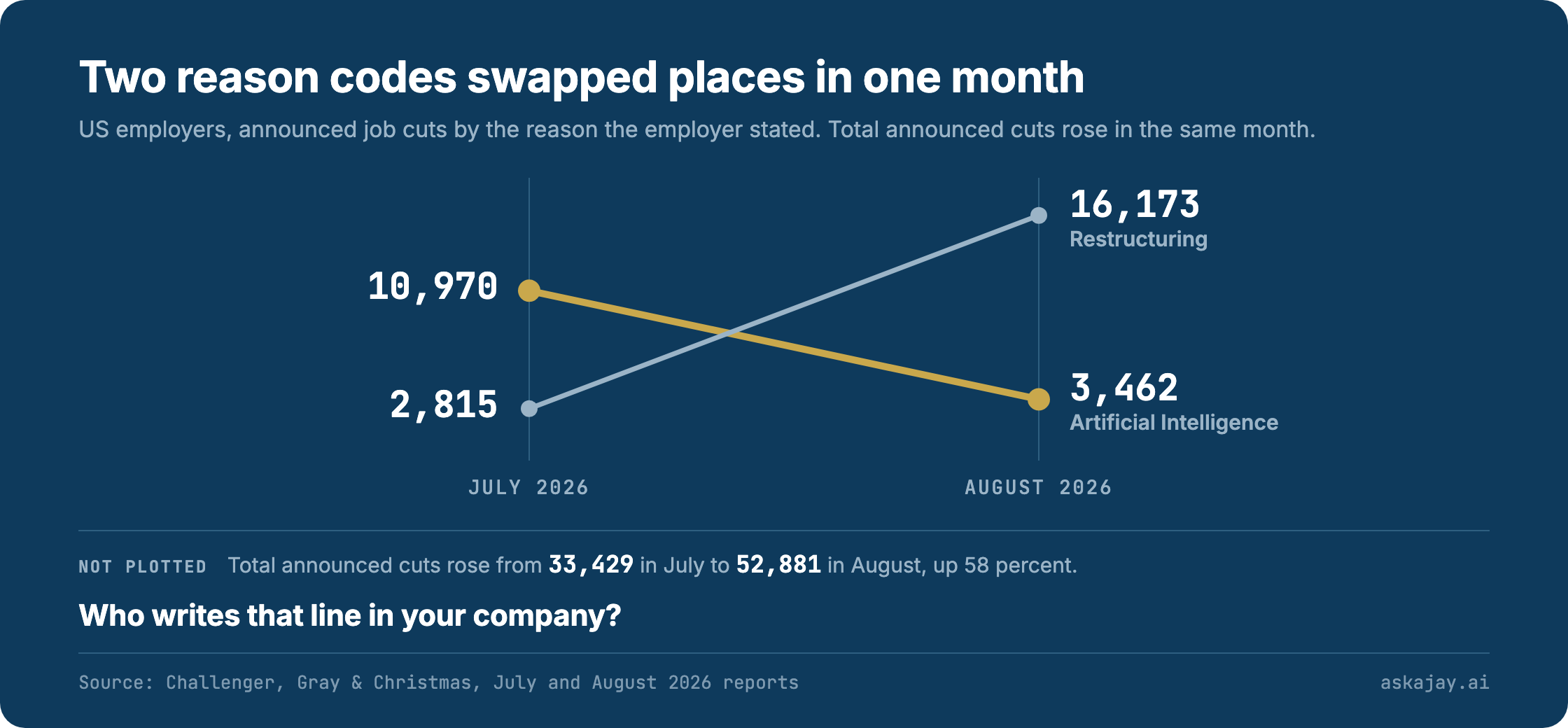
US employers announced 52,881 job cuts in August, up 58 percent from July. That is the headline number. The one underneath it is stranger. Artificial Intelligence, which had been the leading monthly reason since March, fell to fourth with 3,462 cuts, its lowest total since December 2025. Restructuring went the other way, from 2,815 in July to 16,173 in August, and took the top slot.
Read those two facts together. More people lost their jobs in August than in July, and the share whose employer said AI was the reason collapsed. August was also down 38 percent against the same month last year, so this is not a spike in layoffs. Nothing about the technology changed in four weeks either. No model was withdrawn. No deployment was reversed. What changed was the sentence companies wrote in the announcement, and the audience they wrote it for.
During a closed-door strategy meeting at a regional startup, I watched executives mask a failed product launch by blaming the layoffs on 'generative AI integration', a technology their own engineers hadn't even adopted yet.
The number everyone quotes as a measure of AI displacement is a count of what employers chose to say. That is not a small distinction, and August is the month it became visible.
The Decoder
Challenger publishes the reasons employers give for announced cuts. That phrasing is doing more work than most coverage allows. The series records the reason stated in the announcement. It does not verify cause and has never claimed to. The firm said as much in July, flagging "the ambiguous nature of what constitutes AI-attributed cuts" in its own report. It even keeps a separate bucket, Technological Update, possibly AI, for companies that name new technology without tying it to the cuts. That bucket held 20,219 cuts in 2025. I have stopped reading the monthly figure as a displacement number, because it is a disclosure number, and disclosures have authors.
The Steelman
The case for ignoring one month is strong, and I want to put it properly. Restructuring genuinely surged: telecommunications alone announced 4,113 cuts in August, nearly all from a single restructuring. Monthly reason data is noisy and one crossing is not a trend. The year to date still points the other way, with AI cited in 116,175 announcements, roughly 22 percent of all cuts and still the leading reason for 2026. If you want to read August as an artefact rather than a signal, the data will let you do it.
"Naming AI in a layoff announcement can win over investors while pushing current and prospective employees away. That's why the messaging has swung from hedging to aggressively citing it."
That is Andy Challenger, the firm's chief revenue officer, in its July report, describing his own data. The label is chosen, with an audience in mind. Once you accept that, the series stops measuring what AI does to work and starts measuring what companies find it useful to say.
The August report runs to a few pages, and the table of stated reasons near the end is the part worth your two minutes this week.
The Playbook
The Monday move. Pull your organisation's last workforce announcement, internal or external, and find the single sentence that states why. Then answer three questions about that one sentence.
Who drafted it. In most companies it is communications or investor relations working from a brief. The leaders who ran the affected function often see the wording after it is written, and occasionally after it has gone out. If that is true where you are, the reason line is being written by people who were not in the decision.
What was it optimised for. A reason that reads as strategy lands differently with an analyst than with the team being cut. If your announcement named a technology, ask whether anyone checked that claim against what the technology had actually absorbed.
What would have falsified it. This is the question I care about most. If the stated reason was AI, someone should be able to name the work the system now does that people used to do, and roughly how much of it. If nobody can, the sentence described an intention rather than a finding.
Then write the honest version for internal use, whatever the external one says: what work moved, where the people went, and whether you redeployed or reduced. You never have to publish it. You do have to be able to produce it.
The Signal
Challenger added a warning in July that has aged fast. As regulations take shape, the firm said, companies will be even more careful in their announcements, which would make tracking the impact of AI on jobs more opaque. August is what careful looks like. The count that everyone treats as the running total of AI displacement will get quieter exactly as the question gets louder, and quiet reads like good news. It will not be a measurement of the technology. It will be a communications decision, aggregated and published monthly.
The Last Laugh
Every one of those announcements had a draft, and every draft had an editor. The reason line is the most carefully written sentence in a layoff notice and the least audited figure in the AI economy. It is then aggregated into a national statistic and quoted back to boards as evidence. We have built a way to measure artificial intelligence by reading press releases about it, monthly, and treating the total as data.
The Correction
As reported: IBTimes UK, on 3 September, headlined its report "AI Not the Biggest Villain This Time" and wrote that AI was not the main driver of August job cuts, and that corporate restructuring was.
What the source says: Challenger records the reason an employer states in its own announcement, never a verified cause. Its wording is that AI "has been cited in" 116,175 announcements this year. The July report went further, naming "the ambiguous nature of what constitutes AI-attributed cuts". A cited reason measures disclosure, so neither month identifies a driver. Challenger, Gray and Christmas, August 2026 report
The Framework
This is exactly why I built the The Agentic Work-Unit Ledger.
The Ledger closes with two lines most measurement skips: state whether the absorbed work meant redeploy or reduce, and name the human who carries what is left. August is a month where the saying visibly detached from the doing, which is the case for writing both down.
Your Agent Isn't a Feature. It's a Hire. Measure It Like One. →On My Radar
- Sam Altman put a name to it in February: "there's some AI washing where people are blaming AI for layoffs that they would otherwise do, and then there's some real displacement by AI of different kinds of jobs."
- Challenger keeps a second bucket, Technological Update, possibly AI, for cuts where a company names new technology without tying it to the layoffs. It held 20,219 cuts in 2025, none of them counted in the AI figure.
- Researchers found roughly 18,000 posts from OpenAI-attributed agents on a dormant German wiki between May and July. OpenAI confirmed the incident and said it has no clear standard yet for reporting this class of behaviour.
Find your last workforce announcement this week and name the person who approved the sentence that says why. If that name is hard to find, you have learned something more useful than the number.
Know someone who needs this? Forward it to the CHRO who has to approve the wording of the announcement.
Ajay's views, from 15 years in the field. Not legal or compliance advice. See full disclaimers →