The Steelman
Start with the case for the ramp, because it's better than the jokes about it.
Tesla showed the new Roadster in November 2017 and took $50,000 reservations, $250,000 for a Founders Series car, for a car due in 2020. Last Thursday, at a SpaceX test site in Texas, a Roadster drove up a ramp that curled back over itself, left the end upside down, rolled half a turn in the air and landed on its wheels. That is hard engineering, done live.
Spectacle is also how hard things get paid for. A demo like that recruits engineers who want to build it and buyers who want to own it, and nobody who paid $250,000 in 2017 thought they were ordering a Corolla. With agentic coding, a small team can stand up a convincing, working demo in a week. That's a real gain. You learn early whether an idea is worth anything, for a fraction of what discovery used to cost.
Now count the dates. Production was promised for 2020. In July 2020 it was 12 to 18 months away. Then 2022, then 2023. In May 2023 it was "hopefully" 2024, and Musk added, "this is not a commitment." Then 2025. Then a demo on 1 April 2026 and production 12 to 18 months after it. Last Thursday it was 2028, and Musk told the crowd, "Turns out the future does have flying cars."
Seven targets set and missed in nine years, each one just ahead of the day it was set. Thursday's 2028 is the eighth. I've called this Promise Arbitrage: a promise costs nothing at the table where it's made and everything at the table where it's delivered. The demo books the credibility. The delivery date absorbs the bill.
Look at what the ramp left unanswered. Who certifies a car that leaves the ground? A day later the FAA said the vehicle doesn't meet its definition of an aircraft. Tesla's own site says the flying model isn't approved for public roads. The hardest questions about the product were nowhere in the show, because a show can't carry them.
In the past few years I have watched several companies arrive with a fantastic demo, built fast thanks to agentic coding, and fail on governance every time, because the focus was always on a good-looking technical demo. The Roadster runs the same pattern, slowed down to nine years so you can watch it.
Nine years of next year
Said 15 Oct 2026(8 of 8)
Production: 2028
"Turns out the future does have flying cars." Production in 2028.
Elon Musk at the Roadster showcase, as reported by Fox Business Source
| Promise made | Promised production | What was said | Who | Source |
|---|---|---|---|---|
| Nov 2017 | 2020 | "The Roadster, which won't be available until 2020." $50,000 to reserve, $250,000 for a Founders Series car. | Tesla at the Semi reveal, as reported by Fortune | fortune.com |
| Jul 2020 | Within 12 to 18 months | Production "in the next 12 to 18 months". | Elon Musk on the Q2 2020 call, as reported by Electrek | electrek.co |
| Jan 2021 | 2022 | "Finishing engineering this year, production starts next year." | Elon Musk on Twitter | electrek.co |
| Sep 2021 | 2023 | "Assuming 2022 is not mega drama, new Roadster should ship in 2023." | Elon Musk on Twitter | www.electrive.com |
| May 2023 | 2024, hopefully | "Hopefully" 2024, and "this is not a commitment". | Elon Musk at the shareholder meeting, as reported by Electrek | electrek.co |
| Feb 2024 | 2025 | "Tonight, we radically increased the design goals for the new Tesla Roadster." Reuters reported a target to ship in 2025. | Elon Musk on X | www.businesstoday.in |
| Nov 2025 | 12 to 18 months after an April 2026 demo | A demo on "April 1 of next year", then "production is probably about 12-18 months after that". | Elon Musk at the shareholder meeting, as reported by Electrek | electrek.co |
| 15 Oct 2026 | 2028 | "Turns out the future does have flying cars." Production in 2028. | Elon Musk at the Roadster showcase, as reported by Fox Business | www.foxbusiness.com |
Every production target, plotted against the day it was set. The dashed line is the present, and each promise rides just above it. Dates compiled by Electrek.
The Decoder
Gartner has a name for the enterprise version. Forward-deployed engineering, or FDE, is when a vendor sends its own engineers to sit inside your company and build the agent for you. It's fast, and it demos well, because the people who built it are in the room.
On 29 September Gartner predicted that by 2028, 70% of enterprises will abandon agentic AI built this way, trapped by soaring costs and unable to evolve the system in-house. Its advice starts in the right place: "FDE success starts with getting the engagement structure right, from scope and incentives to governance, ownership, and exit." The model works. Nobody inside owns it.
The break comes at the handover, when the engineers leave and the system they built stays behind with nobody on your payroll who can say why it does what it does.
A demo proves one thing: that it can be built. Who owns it, who can stop it and who pays when the date slips never make it onto the stage.
I want more demos, and cheaper ones. What I want alongside them is the questions the demo skips, asked before the contract is signed, while the vendor still wants your signature.
I wrote thirty of those questions down, in six categories, with ten red flags that override any score: Your AI Vendor's Demo Was Built to Pass Your Questions.
The Playbook
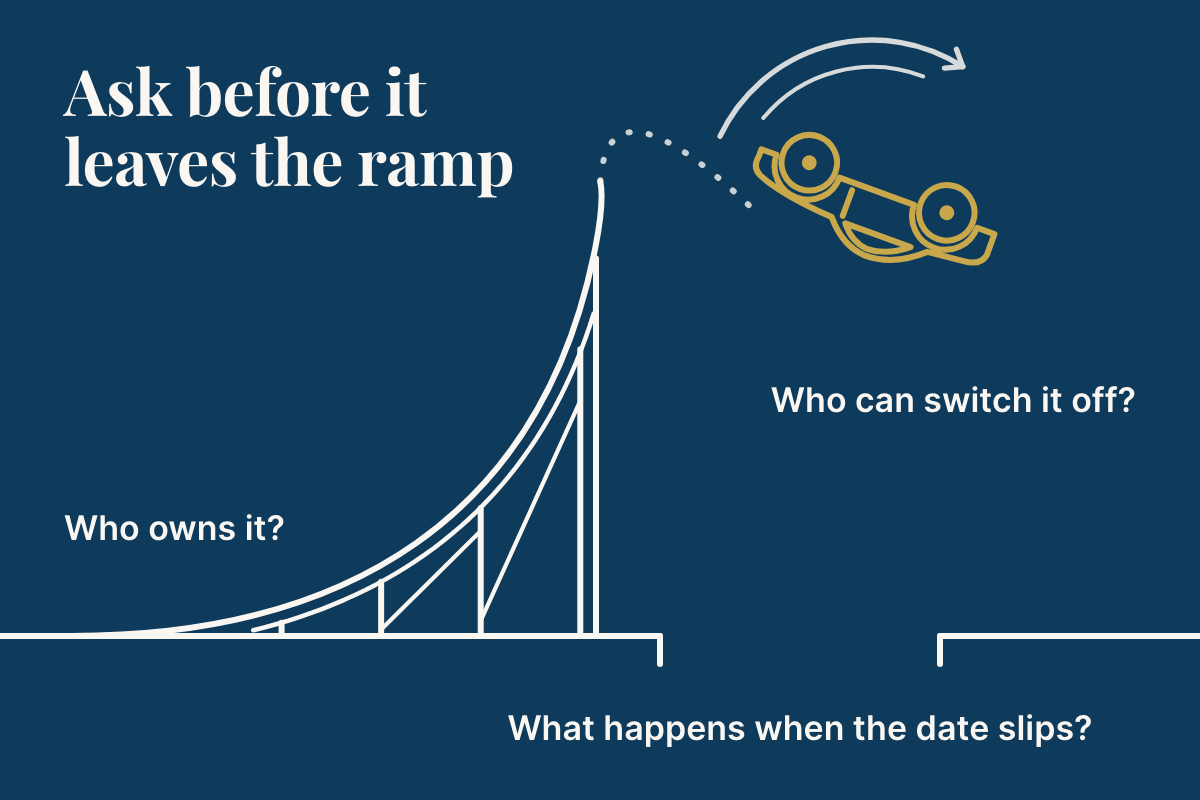
The demo is the ramp. The road, the licence and the insurance come later, and that's where the bill arrives.
Pay for delivery, not for the demo. Tie each payment milestone to the system running on your data, at your volumes, operated by your people. A demo on the vendor's laptop is a sales asset. Price it like one, at zero.
Write the slip into the contract. Every date on a vendor roadmap is a Roadster date until missing it costs something. Ask for a fee reduction or an exit right when a committed capability slips by more than a quarter. A vendor that believes its own dates will sign.
Name the owner before the pilot starts. One person on your side who can explain how the agent decides, who can switch it off, and who answers when it gets something wrong. If that name doesn't exist on day one, the pilot is a demo with a longer run time.
Rehearse the handover. Gartner's 70% will be the companies that can't change the system once the vendor's engineers go home. Before go-live, have your own team make one real change to it without vendor help, and time it.
Keep the demo as evidence. Record it, with the date and everything promised on the call. Six months later, run the same script on the live system. The gap between the recordings is your real roadmap (and your best renewal argument).
The Signal
Watch who ends up regulating the flying Roadster. The FAA has said it isn't an aircraft, the road version still has to meet federal vehicle safety rules, and production is two years out. The show is over and the governance work starts now, after the deposits. I keep seeing companies do it in that order too.
The first enterprise AI vendor to publish, for every agent it has handed over, who owns it now and how often its dates slipped will have something more persuasive than a ramp.
The Correction
As reported: CBS News headlined last Thursday's event: "With Tesla Roadster debut, Elon Musk shows 'flying cars are real'."
What the source says: The FAA told CBS News a day later: "The Tesla vehicle does not meet the FAA definition of an aircraft." What the car did was climb a ramp, turn over in the air and land. Tesla's own site says the flying model is not approved for public road use. FAA statement to CBS News, 16 October 2026
The Framework
This is exactly why I built the Promise Arbitrage.
Promise Arbitrage says a promise is free where it is made and expensive where it is delivered. The Roadster is the cleanest public case of it: seven production dates, each priced at zero on the day it was said.
Promise Arbitrage: Why Nobody Prices an AI Promise Until Engineering Pays It →On My Radar
- Gartner predicted in June 2025 that over 40% of agentic AI projects will be canceled by the end of 2027, and warned about "agent washing", the rebranding of existing products such as AI assistants and chatbots.
- Its September 2026 release adds "FDE washing", where consulting services are marketed as forward-deployed engineering, and predicts that through 2028 less than 20% of FDE engagements will turn recurring customer needs into product capabilities.
- Electrek kept the running list of every Roadster date before Thursday, from the 2017 reveal to the 1 October event that was postponed to the 15th.
Enjoy the ramp. It was fun to watch. Then ask your next vendor the question the show skipped: who owns this once it lands?
Know someone who needs this? Forward it to the person about to approve an agentic AI pilot because the demo was great.
Ajay's views, from 15 years in the field. Not legal or compliance advice. See full disclaimers →