The Steelman
The case for one vendor is strong, and most companies chose it for sound reasons.
One suite means one login, one set of security settings, one contract and one bill. Mail, calendar, files and meetings already live there, so an assistant from the same vendor can read all of them on day one, under permissions you set years ago. Nobody has to build a connector. When Microsoft listed what its Copilot might lose last week, it named the thing people bought it for: access to "work data such as email, calendar, and files."
The alternative is worse than it sounds. Five vendors mean five sets of admin rights, five places a leaver's account can linger, and an integration team with a job for life. On an ordinary day consolidation is the safer bet, and I think most companies were right to make it.
Then came Thursday 12 November 2026. Microsoft's status page said users "may be unable to connect to multiple Microsoft 365 services". The damage was to features "that interact with Exchange Online and email services". That is one mail service. The list under it ran to twenty, from Exchange Online to Windows 365.
The assistants felt it. Microsoft 365 Copilot was on the list, and two assistants Microsoft doesn't own had trouble the same day. Anthropic's status page logged "Elevated errors affecting the Microsoft 365 connector" and later said the issue "is caused by a Microsoft 365 service incident". OpenAI filed an incident with the identical title and gave no cause. Neither page said its model was down. Both said the route into the mailbox was.
I'd had a small version of this myself. Last week, my AI calendar assistant silently stopped scheduling client follow-ups for four hours, and I only realized it when I checked the logs and saw its underlying workspace OAuth token had expired without throwing a visible error. Mine was silent and Microsoft's was public, but the shape was the same: the layer under the assistant had gone.
I'd still choose one suite. What I didn't have, and I suspect most companies don't either, is a written list of what each assistant stands on.
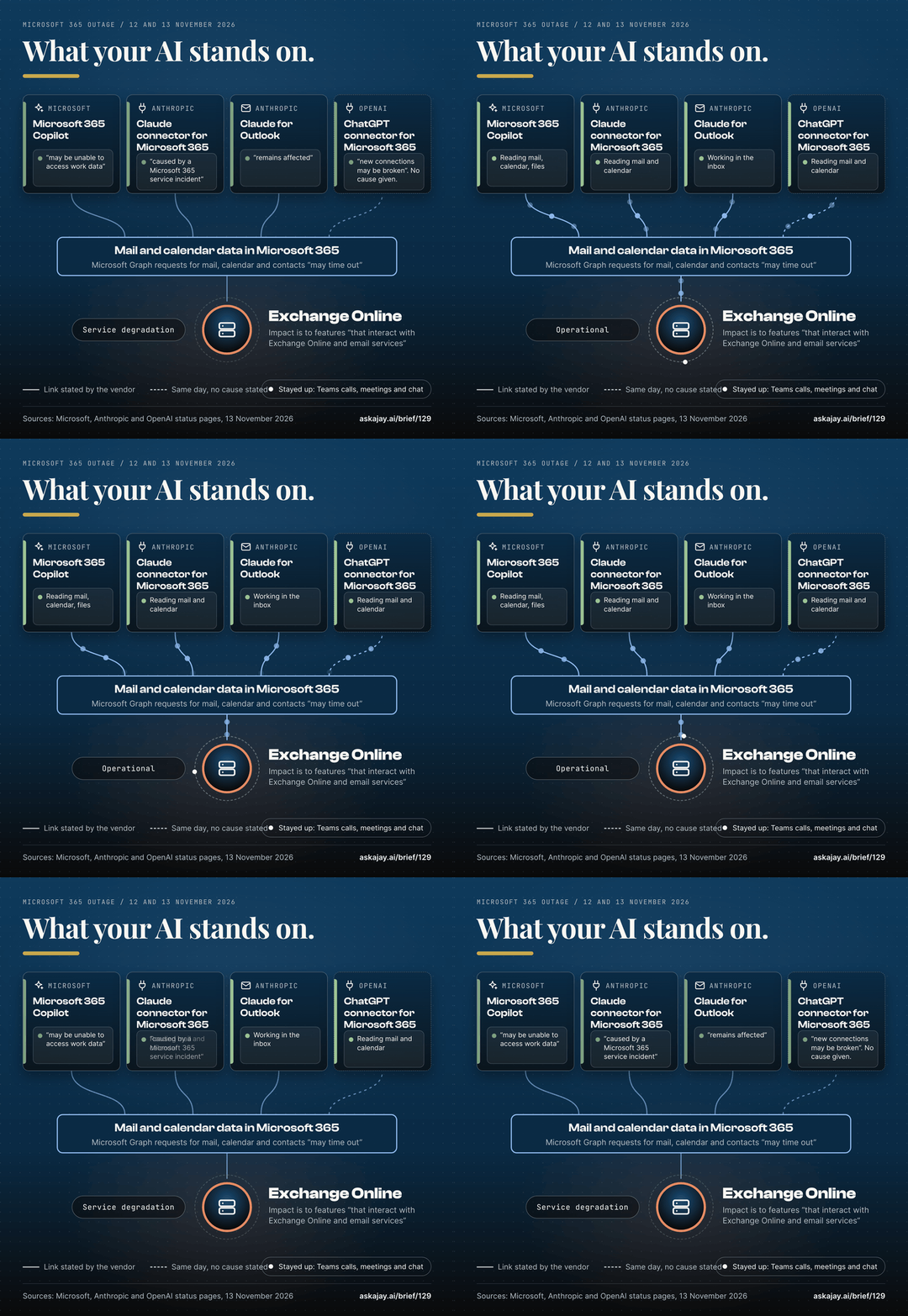
What stopped when one mail service did, in the vendors' own words from their status pages on 12 and 13 November. OpenAI's line is dashed because it stated no cause.
The Decoder
A connector is the software that lets an AI model read and act inside another system. It holds a permission, usually an OAuth token, and passes the model whatever the other system sends back. Microsoft's own route to that data, Microsoft Graph, was on the status page too: requests for mail, calendar and contacts "may time out".
So an assistant stands on at least three things: the model, the connector with its token, and the system being read. Any one can fail while the other two look healthy. Nobody publishes your company's whole stack, so you draw it yourself, ideally before an outage does.
An assistant is only as available as the least reliable thing it reads from, and most companies have never written down what that is.
Nobody should split their mail across vendors to protect a chatbot. When the mailbox is down, nobody needs an assistant to read it anyway. The list earns its keep on the other days: the lapsed token, the changed connector, the follow-up that never went out.
I set out the three layers of AI you rely on without running, and five steps for governing them, in The AI That Hurts You Is Not the AI You Own.
The Playbook
List what each assistant stands on. An AI dependency map is one line per assistant: the model, the connector, the system it reads, and who owns each (a spreadsheet will do). Start with the ones that touch customers or money.
Find the shared layer. Sort that list by its bottom row. If one service sits under most of it, that's your concentration. That's fine if someone chose it on purpose.
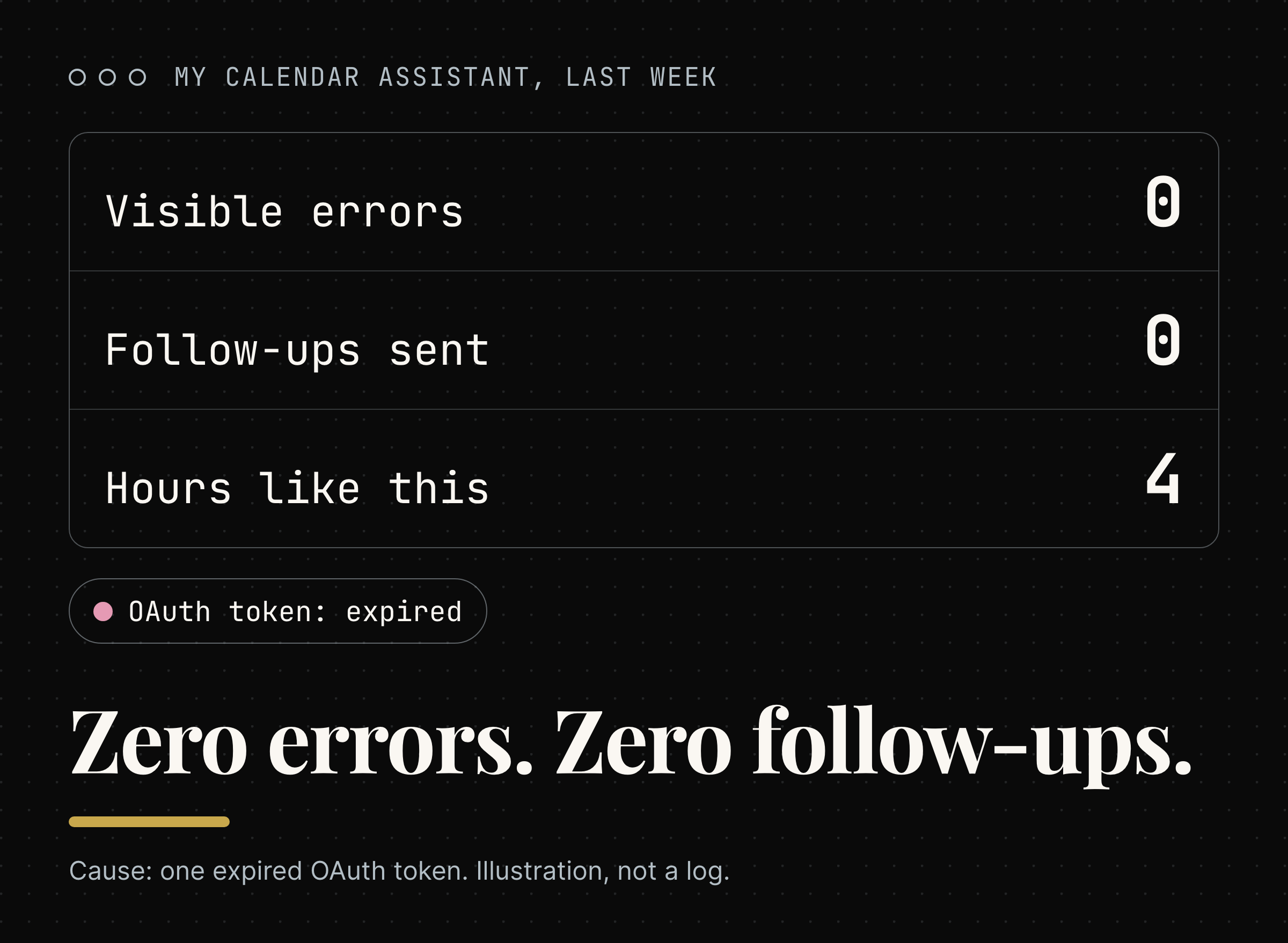
What my dashboard would have shown, had I built one. An illustration from my own four hours, not a log.
Make silence visible. My calendar assistant failed for four hours without an error. Give every agent a count of actions per day that a person sees, and an alert when the count drops well below a normal day. A quiet agent and a broken one look identical until someone counts.
Write the fallback in one sentence. For each assistant: when it's down, who does the work, and how. Then run it once, on a quiet afternoon, before you need it.
Ask the vendor for its dependency list. At renewal, ask which outside services the product needs while it runs, and whether its status page reports their failures. Anthropic's did last week: it named Microsoft's incident as the cause and pointed customers to Microsoft's page. Ask every vendor to meet that bar.
The Signal
Watch for Microsoft's Post-Incident Report. The company has promised one "with root cause and defense-in-depth actions" once mitigation is complete.
More agents are arriving. In a Genpact survey of more than 2,000 executives, published the day the outage began, 79% of enterprises said they have AI agents in production, and 15% have fully tied AI investment to P&L outcomes. Genpact sells AI operations services and the findings are self-reported, so read them as a vendor's numbers. An expired token cost me four hours of follow-ups. Before your next agent goes live, ask what it stands on.
The Last Laugh
My favourite line on Microsoft's page was about Teams. Most core functions, "including joining calls, meetings, group chats, and channel messages", were not affected. So anyone wanting a meeting about the outage could still join one. The people fixing it had a long week, so my joke is about the architecture only. Still, the talking about the work held up better than the work.
The Correction
As reported: Invezz headlined on 13 November: "Microsoft outage spreads to OpenAI and Anthropic: how did it get this bad?"
What the source says: What failed at both companies was the connector into Microsoft 365. Anthropic's status page titles its incident "Elevated errors affecting the Microsoft 365 connector" and says it "is caused by a Microsoft 365 service incident". OpenAI's incident carries the same title. Invezz's own summary, under that headline, says the "AI models stay online". Anthropic status page, incident opened 12 November 2026
The Framework
This is exactly why I built the AI Vendor Assessment Scorecard.
Its sixth category, lock-in and portability, asks whether you depend on a vendor's proprietary formats or tools. Last week put the same question one layer down: what does the vendor's product depend on while it runs? Ask both before you sign.
Your AI Vendor's Demo Was Built to Pass Your Questions →On My Radar
- Within about an hour of the first problems, the outage tracker Downdetector had logged reports from 74 countries and territories, Al Jazeera reported. Those are user reports, which is a different thing from confirmed disruption.
- OpenAI's first incident note said new Microsoft connections "may be broken and tools are not working as expected". It named no cause.
- From the same Genpact survey: "On average, just 49% of AI initiatives funded in the past 24 months have delivered the value expected."
This week, pick one assistant and ask what it stands on. If the answer is a long pause, write the pause down as line one.
Know someone who needs this? Forward it to the operations lead who signed off the AI assistant rollout and has never seen its dependency list.
Ajay's views, from fifteen-plus years in the field. Not legal or compliance advice. See full disclaimers →